

Most Small Businesses Don't Sell. They Stop.
August 17, 2026

In 2022, an estimated 510,000 small and medium-sized businesses exited the U.S. market, according to research from the McKinsey Institute for Economic Mobility.[1] 92% of them closed outright, with only 5% sold and just 3% transferred to a new owner, usually a family member. That means roughly 469,000 businesses, in a single year, ended not with a transaction but with a shutdown: doors locked, customer relationships and institutional knowledge lost, jobs gone, the tax base that funds community infrastructure quietly eroded, and storefronts left vacant.
This number is projected to keep climbing. The McKinsey Institute for Economic Mobility estimates this:[1] 6 million small and mid-sized businesses will face an ownership transition by 2035 as their owners retire. This will represent up to $5 trillion in enterprise value, tied to as many as 12 million jobs and roughly $250 billion in spending power that helps support your community each year. 27% of owners aged 55 and older, the "silver tsunami" of retiring business owners, are either unsure what happens to their business when they leave or already planning to close it. These may sound like abstract statistics until you look at which market segment this impacts: nearly 80% of the businesses expected to change hands in that window are valued under $2 million, retail shops, consumer goods brands, service-based businesses, small manufacturers, the businesses that employ your neighbors, fund your community, and supply your needs.

Here's the interesting part: buying and selling a business is a relatively common activity. A whole world of investors, lenders, and advisors, backed by real processes, resources, and capital, already helps people do exactly that. The problem is that this world wasn't designed with these smaller, community-facing businesses in mind.
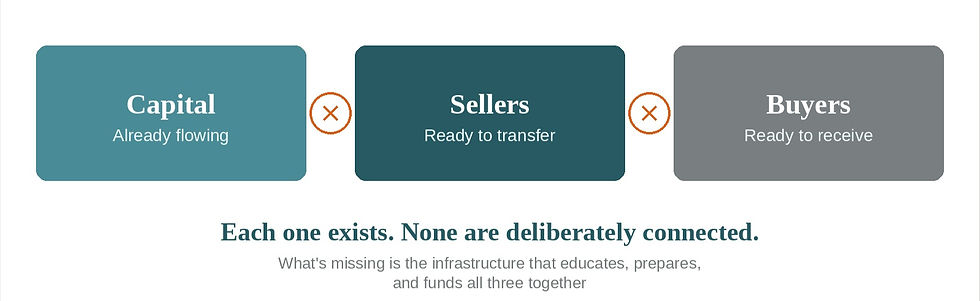
37 Oaks has worked with 60+ global partners, including financial institutions, government agencies, economic development organizations, and corporations, along with thousands of entrepreneurs over the past 10 years. Through this, I've deduced that addressing this opportunity requires three things to work together: capital specifically allocated for business acquisition for this market size, sellers receiving education on how to build a valuable business worth handing off, and buyers receiving education on how to acquire and continue strong operations of an existing business. Each may exist on its own, but they aren't deliberately connected through collectively designed infrastructure that helps educate, prepare, and fund this market.
An Assumption Worth Checking
Most business acquisitions today happen through a specific, well-established model: search funds and private equity, often grouped under the term entrepreneurship through acquisition, or ETA. Investors back an entrepreneur to find, buy, and run an existing business instead of building one from scratch, and the businesses they target follow a consistent profile: EBITDA margins above 15%, recurring or contractual revenue, low customer concentration, low capital intensity, typically generating $5 million or more in EBITDA.
Yet nearly 80% of the businesses actually facing an ownership transition are valued under $2 million, well below where this model is built to operate.
It's a sound model built around business and consumer services, healthcare services, and software, and it works well for what it's designed to acquire, just not for most of what's actually coming to market.
That $2 million line isn't an arbitrary cutoff; it's the business brokerage industry's own boundary. The International Business Brokers Association (IBBA) and M&A Source[2] split the world into "Main Street" (businesses valued at $0 to $2 million) and "Lower Middle Market" ($2 million to $50 million), and it's Main Street where the overwhelming majority of the ownership transitions ahead of us will actually take place.
Ask why smaller retail, consumer goods, service-based, and small-scale manufacturing businesses rarely show up on a search fund target list, and the answer traces back to the same criteria above. Search fund advisors are direct about it: they steer away from retail, restaurants, and other highly commoditized industries specifically because of thin, unpredictable margins.

That's where a quieter assumption tends to take over: that if a business doesn't clear the bar search funds and private equity set, it must not be profitable enough, not big enough, or too risky to be worth anyone's investment. But that bar measures fit for a specific kind of investor, one that needs a business to resell at a multiple within a few years, not whether a business is fundamentally viable. A business can carry solid margins, support real jobs, have genuine room to grow, reliably repay a loan, and still fall outside a search fund's range for reasons that have nothing to do with its underlying value. Clearly, this is a valuable segment. According to the U.S. Small Business Administration's Office of Advocacy,[3] small businesses make up 99.9%, or 36.2 million, of all businesses in the United States. They carry real economic weight by employing nearly 46% of private-sector workers, generating 43.5% of U.S. GDP (roughly $13.7 trillion), and producing roughly 9 of every 10 net new jobs in the most recent year of data.
CDFI and SBA Lending Already Say Otherwise
There's another sign of this Main Street market's viability: lenders only make money when a loan is repaid, not when a business resells at a multiple, and they're already financing this exact market at scale. According to the SBA's own reporting,[4] SBA 7(a) lending, the federal loan program most commonly used to finance small business purchases, ran between $33 billion and $36 billion in fiscal year 2025, up more than 20% from the prior year, a substantial investment by any measure.

CDFIs (Community Development Financial Institutions) are also active in this market, and at meaningful scale. According to research from the Federal Reserve Bank of New York,[5] CDFI loan originations reached $67 billion across all collateral types in 2022, the most recent year with comprehensive data. This is more than double the $29 billion originated in 2018, with business and commercial lending making up a substantial share of that volume, a scale comparable to SBA's $33 billion to $36 billion in annual 7(a) lending. Separate New York Fed research counts 1,378 certified CDFIs nationwide, holding $446 billion in combined assets.[6] They are growing at a time when mainstream banks are showing retreat from small business lending: the Federal Reserve Bank of Kansas City's most recent small business lending survey found new loan originations fell 9% year over year.[7]
Relationship-based, character-driven underwriting is another reason CDFIs fit this market so well: it asks directly whether a business can service a loan, not whether it can be flipped for a multiple. That's a much better fit for a retail shop, a service business, or a small manufacturer built for consistent, sustainable operation on Main Street. Neither SBA nor CDFI lending is chasing that kind of flip. Both are underwriting toward repayment, and a lender only extends credit when a business can demonstrate the cash flow to support it. That's real, provable value, just measured and reached differently than search funds and private equity require.
The fact that search funds and private equity pass on this market isn't a viability problem; it's a targeting problem.
Search funds and private equity are built to find and finance one kind of business, and businesses like these fall outside that target, even though they're financeable, valuable, and already proving it at real scale. The financial infrastructure to fund this market already exists; SBA and CDFI lending are doing it. What's still missing is the deliberate connection to the people on both ends of that transaction, starting with the sellers who'd need to be ready to use it.
The Sellers Aren't Ready Either
The seller side of the ownership-transfer wave carries a readiness gap of its own. A 2026 Chase survey found that while roughly 4 in 10 small business owners plan to retire within the next decade, only 8% say they're fully prepared to transfer ownership.[8] That's not an isolated finding: the Exit Planning Institute's National State of Owner Readiness Report puts it even more starkly, fewer than 1 in 3 business owners have a documented exit plan at all.[9]

That gap includes two points sellers are not often taught: how to build a business valuable enough for sale, and the practical work it takes to create that value in the first place. On the first, most owners simply can't name what's actually driving their business's worth. A First Citizens Wealth study found only 52% of business owners know their exact business worth, and 44% say they lack confidence in their own value assessment.[10] On the second, most don't understand which concrete levers build value, such as how to systematize and document a process, map where time and effort leak out of daily operations, or structure a team so the business doesn't run on one person's memory. An owner missing either of these isn't running a business a buyer can step into confidently, no matter how strong the numbers look on paper. When that same owner converts informal, founder-dependent processes and insights into real, value-building systems, that's exactly what makes the business worth acquiring and sellable in the first place.
Readiness, in other words, isn't a one-sided problem. The same operational gaps that keep an owner from selling are the exact gaps a new operator will need filled the moment they take over. It's the same kind of readiness, just approached from opposite ends of the same transaction.
An Overlooked Pool of Buyers
When search funds buy, they typically fund entrepreneurs with finance and deal-making experience, not necessarily people with a lot of day-to-day operational experience. That's by design. A board of experienced investors exists specifically to fill that gap, coaching them, catching their mistakes, and keeping them from learning the hard way. That structure works, but it only exists at deal sizes large enough to support it, above that same $5 million threshold.
Below that, in the world where most Main Street retail, consumer goods, and service businesses actually sell, there's typically no board and no investor mentorship system. Lenders evaluating self-funded buyers, whether SBA or CDFI financed, say plainly that what predicts success is an operational track record. A buyer who managed a retail store and now wants to acquire a bakery brings something real to the table: customer service instincts, inventory discipline, staff leadership. A former corporate Human Resources professional who's never run their own business but has spent a career managing people, staffing, and workplace operations brings a lot of value to a growing staffing company.

That operational track record shows up clearly in two populations well positioned for these acquisitions, and both are only growing in number. The first is what we'll call Displaced Talent: the unemployed, laid off, and furloughed. According to Bureau of Labor Statistics data,[11] a record 105.8 million Americans were counted as out of the labor force in June 2026, surpassing even the depths of the Great Recession and the COVID-19 pandemic. That figure is broader than this group alone; it includes retirees and others outside the workforce too, but continued layoffs across major employers are adding to it through the year, and unemployment, layoffs, and furloughs are a real part of what's driving it. The second is what we'll call Aspiring Acquirers: people with real entrepreneurial ambition who have always wanted to own a business but have no interest in building one from the ground up. Not everyone is built for the startup phase, the years of unpaid effort, personal risk, and slow, uncertain growth it typically takes to carry a business past its earliest stage. That's not a shortfall, as building and operating are different skill sets, and the difference matters more than most people realize.
For both populations, acquisition isn't a workaround, it's a more honest starting point.
Stepping directly into a business that's already past its hardest, most fragile stage is a way to reach ownership without absorbing the risk of the earliest, most fragile years. Both populations tend to bring the same thing: operational skills and a real desire to own and operate a business. Whether it is retail merchandising, marketing, staff management, inventory management, customer service, margin management, or process improvement, the core operational skills are often already there, even if they've never been applied to a business they own. Foundational entrepreneurial education such as business planning, legal structure, and basic bookkeeping is already well covered by Small Business Development Centers (SBDCs) and local chambers. For the next level of education that fuels scaling and preparation for acquisition, there are many aspects of operational readiness required, and although these potential entrepreneurs come with some skills, they need to learn the others. That's a gap 37 Oaks and other advisor organizations are designed to and positioned to help fill.
What This Requires

What's preserved when a Main Street business transfers instead of closing is not a small impact. Research from Civic Economics has repeatedly found that locally owned businesses circulate roughly three times more money back into their local economy than absentee-owned firms or corporate chains.[12] A successful transfer isn't just a business surviving; it's a local economic engine staying intact in a way no chain location or empty storefront can match. Scale that up, and McKinsey's 2035 numbers stop being abstract too:[1] up to 12 million jobs and roughly $250 billion in annual local spending power, either lost with each closure or kept in the community with each successful transfer. A business that closes transfers zero wealth to its owner and zero continuity to its community. A business that sells or transfers keeps jobs local, keeps spending local, and keeps the tax base that funds local infrastructure and services intact.
We have discussed that search funds and private equity, by their own criteria, have little interest in businesses under $5 million in EBITDA. Meanwhile, the businesses actually leaving the market, valued at $2 million or less, are taking their tribal knowledge, their jobs, and their local economic weight with them when they close. This comes down to the same three-part gap outlined at the start. Real sellers with businesses worth transferring exist, though many don't yet know how to become sellable. A real, overlooked pool of buyers exists to meet them, capable operators with real experience but no clear path to ownership. And real capital exists too; it just hasn't been pointed at acquisition specifically. What's missing is exactly what I opened with: collectively designed infrastructure that helps educate, prepare, and fund, connecting all three instead of leaving each to exist on its own.
Institutional partners, such as CDFIs, SBA lenders, financial institutions, government agencies, economic development organizations, and corporations, should treat acquisition readiness as infrastructure worth building alongside the launch-stage support they already fund. 37 Oaks' operation- and scaling-centric courses, coaching, and resources, plus financial products and lending acumen built specifically for this kind of acquisition, prepare a seller to transfer a strong business and an operator to keep running one, with continued impact to the community on both sides of that transition.

This structure isn't new for 37 Oaks. Programs like Definition Innovator, delivered in partnership with Definition Theatre and Promise Holdings, and the FedEx E-commerce Learning Lab, delivered in partnership with FedEx, already link funding to completed 37 Oaks programming. Our curriculum has been a prerequisite for small businesses to receive close to $2.4 million in funding since 2016.
This is proof the model works. What's left is applying it at scale, to the seller preparing to transfer and the operator preparing to receive, matching the size of the 6 million ownership transitions ahead of us. The businesses are real, and so are the people ready to keep them running; what happens next depends on whether the field decides to connect them. The question is whether we build the infrastructure to keep them open before the next 469,000 close.
Terrand Smith
Founder/CEO
37 Oaks

Who is 37 Oaks?
37 Oaks is a global commerce development company that translates the complex language of commerce, distribution, and scaling into something entrepreneurs can learn, apply, and build with — turning growing businesses into scalable enterprises and stronger economies.
Sign Up For Our Newsletter.
Sources
McKinsey Institute for Economic Mobility, "The Great Ownership Transfer: A new era of business stewardship" — mckinsey.com
International Business Brokers Association (IBBA) and M&A Source, Market Pulse Survey — ibba.org
U.S. Small Business Administration, Office of Advocacy, "Frequently Asked Questions About Small Business 2026" — advocacy.sba.gov
U.S. Small Business Administration, 7(a) & 504 Activity Reports — data.sba.gov
Federal Reserve Bank of New York, "Examining the Origination and Sale of Loans by Community Development Financial Institutions" — newyorkfed.org
Federal Reserve Bank of New York, "Sizing the Community Development Financial Institution Industry: 2011-2025" — newyorkfed.org
Federal Reserve Bank of Kansas City, Small Business Lending Survey — kansascityfed.org
Chase, "Local Snapshot: Most Small Business Owners Aren't Prepared for Succession" (2026) — media.chase.com
Exit Planning Institute, National State of Owner Readiness Report — exit-planning-institute.org
First Citizens Wealth, "Beyond Wealth" study on affluent business owners — stocktitan.net
U.S. Bureau of Labor Statistics, Employment Situation report, June 2026 — bls.gov
Civic Economics, local multiplier research, as summarized by the American Independent Business Alliance — amiba.net


Really enjoyed reading this. The points around Business Acquisitions and helping small business owners prepare for a smooth ownership transition were especially interesting. It’s a practical perspective on a topic that doesn’t get enough attention. Great read!
What an insightful article. I learned a lot and I can see the huge gap! Thanks Terrand!